
My traffic dropped: a diagnostic guide to Google traffic drops
A complete guide to diagnosing a Google traffic drop: confirm it is real, find the right cause among updates, manual actions, or errors, and what to do.
highlights
- Before diagnosing, confirm the drop is real: compare equal periods, look at least 90 days back, and check for filters applied by accident.
- The shape of the curve, vertical, step, or ramp, already points to the most likely cause before any audit.
- The four most common fronts are manual action, algorithm update, technical error, and a drop with no apparent cause.
- Document the exact date of the drop and everything that changed on the site before rewriting content or switching agencies on impulse.
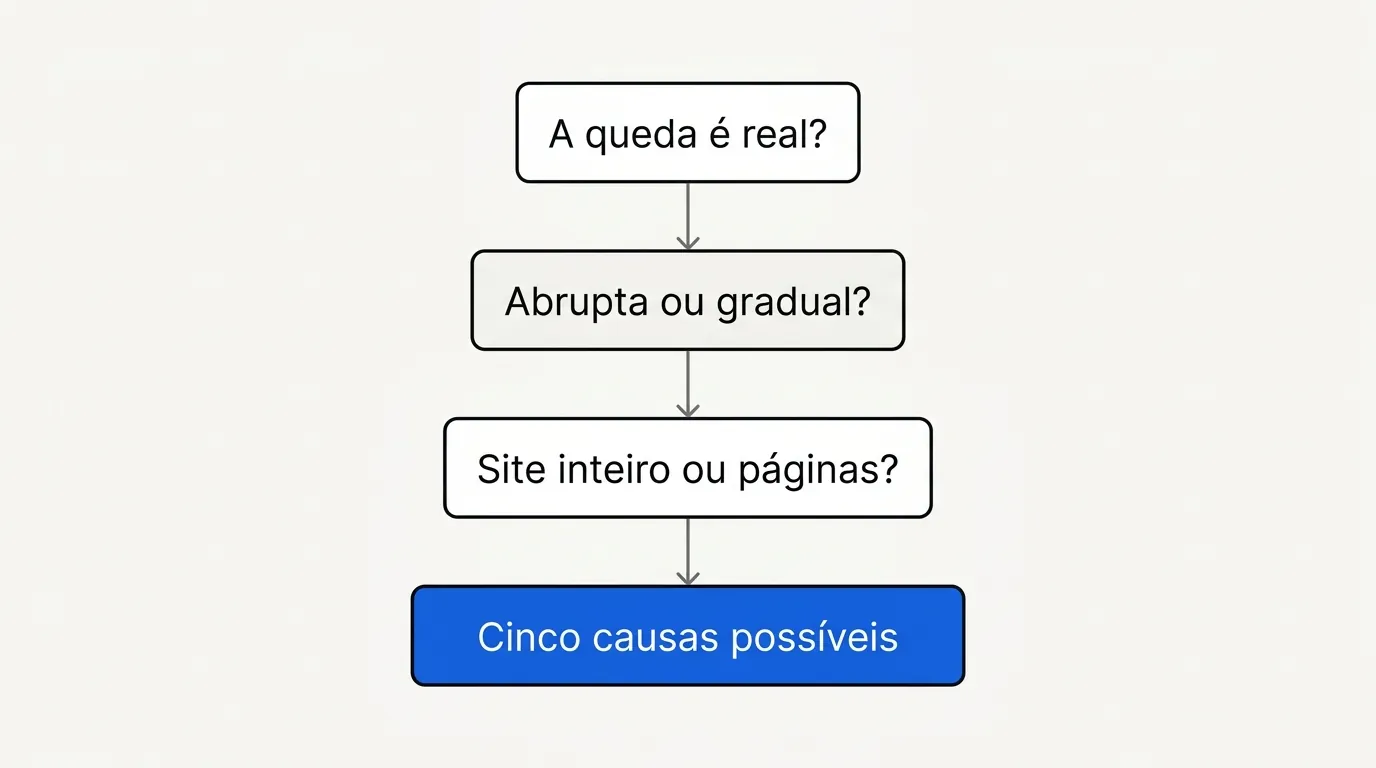
Before touching anything, answer three questions: is the drop real, was it abrupt or gradual, and did it hit the whole site or just a group of pages. The answers to these three questions eliminate most of the wrong hypotheses and point straight to the likely cause, long before you open Search Console line by line.
This matters because the most common reaction, when the graph tanks, is to change titles, rewrite content, and touch redirects all at the same time. Three weeks later nobody knows what worked, because everything changed together. Diagnosis first, action after.
This guide is the starting point for anyone who needs to investigate a traffic drop. It walks you through the decision tree and sends you to the right content: manual action, core update, spam update, Helpful Content Update, or the most frustrating case of all, the drop with no apparent cause.
Is the drop real, or is it a measurement problem?
Before any technical diagnosis, rule out measurement error. According to Google Search Central, a meaningful share of the drops reported by sites are not real drops at all: they are Search Console data lag (which can take up to 2 days to settle), comparisons between unequal periods (a 28 day month against a 31 day one), or normal fluctuation in a series with little data.
Quick checklist before panicking:
- Compare the same range of weekdays (Tuesday with Tuesday, not Tuesday with Sunday).
- Look at least 90 days of history, not just the last 7.
- Confirm there is no country, device, or search type filter applied by accident in the report.
- Check whether GA4 and Search Console tell the same story. If only one dropped, the problem may be tracking, not SEO.
If the drop is still there after this, it is real. Now the work is to find out its shape.
The shape of the curve already rules out half the hypotheses
How traffic dropped says more than any audit tool. Three patterns cover most cases:
| Shape of the curve | What it usually indicates | Where to investigate first |
|---|---|---|
| Vertical drop, overnight | Manual action, technical error (broken deploy, robots.txt, mass noindex) or a security block | Manual actions and security issues report in Search Console, recent deploy log |
| Step over a few days (plateau, further drop, plateau) | Rollout of an algorithm update (core or spam), which takes days to spread | Date of the drop against Google's update calendar |
| Ramp, slow decline over weeks or months | Loss of competitiveness: aging content, a competitor gaining ground, a shift in search intent | Specific pages and queries that have been slowly losing position |
This split saves time, even though it is not absolute. A site that describes "it dropped 97% overnight" (a real case seen in SEO forums) does not have the same problem as a site that has been losing 5% of traffic a month for the last six months.
In practice: I always ask to see the daily impressions graph before hearing any theory about the cause. The shape of the curve cuts the hypotheses in half in five minutes.
The four fronts that explain almost every drop
After confirming the drop is real and identifying its shape, there are four main fronts to investigate, in this order of probability and ease of confirmation:
1. Manual action or security issue
This is the easiest cause to confirm and the most misunderstood one in SEO forums. Many people ask "can I be penalized forever?" or "can a 404 link penalize my site?" without first checking the official report, which shows this in seconds.
Go straight to Search Console, open "Manual actions" and "Security issues". If anything is listed there, you have a confirmed manual action, documented in the report itself. The full diagnosis and fix path is in the article on manual actions and the reconsideration request.
2. Algorithm update (core or spam)
If the drop has a step shape and the date matches an update rollout, the most likely explanation is algorithmic, tied to the rollout itself. The difference between the two types of update matters for what you do next:
- Core update: a broad reassessment of quality and relevance, with no specific target. See the playbook in core update: what to assess and how long to wait.
- Spam update: targets specific practices, such as content generated at scale with no real value. See spam updates and scaled content abuse.
If your site runs on long form, editorial content built over years, and lost traffic broadly after an update named "helpful content", the case is probably something else: see Helpful Content: what we learned about recovery.
3. Technical error that mimics a penalty
A large share of "mysterious" drops are, in fact, a common technical error: noindex applied by accident in a deploy, a canonical pointing to the wrong page, a robots.txt block, or pages that went from "indexed" to "crawled, not indexed". It is worth checking this early, because it is fast to test and easy to fix.
If your pages still show as indexed in Search Console but have vanished from search results, the problem may be in crawl budget and Googlebot behavior or in the indexing status itself. If the drop came right after a domain, CMS, or URL structure change, the path is site and domain migration without losing traffic.
4. Drop with no apparent cause
After ruling out a manual action, a known update, and an obvious technical error, the most frustrating scenario remains: nothing changed on the site, no update was announced, and traffic tanked anyway. It is the most common pattern in SEO reports on forums, exactly because it is the hardest to close. The elimination playbook is in drop with no apparent cause: diagnostic playbook.
When the position holds and the clicks disappear
There is a pattern that confuses a lot of people: the position in Search Console did not drop, impressions even went up, but clicks tanked. The ranking is probably still stable. What changed is the results page itself.
The most common suspect today is the AI Overview, the AI generated summary that appears at the top of search and answers the user's question before they click any link. If your Search Console shows this pattern (stable or rising impressions, falling clicks, dropping CTR), the diagnosis and what to do about it are detailed in AI Overviews and the CTR drop.
 Photo of Martin Splitt by Robert Nowaczyk
What to do while you still do not know the cause
While the diagnosis is still open, there are safe actions and actions that make the problem worse.
Makes sense:
- Document the exact date of the drop and everything that changed on the site in the 30 to 60 days before (deploys, CMS changes, agency changes, migration).
- Segment the Search Console performance report by page, query, country, and device to isolate where the drop concentrates.
- Check whether competitors in your niche reported the same pattern on the same date, which points to something broader than your site.
Does not make sense:
- Rewriting the entire site at once. If you change everything and traffic comes back, you will never know what fixed it, and you will never avoid repeating the mistake.
- Switching agencies or CMS as a first reaction, before having a diagnosis.
- Requesting reconsideration without being sure that a manual action is actually active.
What SEO forums show about this moment
Following discussions among SEO professionals in forums, two patterns repeat often enough to be worth noting. The first is volume: a traffic drop is, by a wide margin, the most common type of report from SEO professionals seeking help, far more than technical implementation or tooling questions.
The second is tone. A meaningful share of these reports function as venting: people asking whether it is worth staying in the business, criticizing Google's lack of transparency about the reason for the drop, or describing months of work that seemed to count for nothing after an update. This reinforces that the diagnostic process, besides being technical, also needs to manage expectations.
Separating these two movements helps decide what to do with the available time. If your moment is one of venting, that is fine, but it does not replace the technical triage work described in this guide. If your moment is one of diagnosis, the earlier steps (confirming the drop is real, identifying the shape of the curve, following the decision tree) are the shortest path to an answer, even when the answer is "I still do not know, but I have already ruled out three hypotheses".
In practice: the professional who recovers traffic fastest is the one who follows the diagnostic order without skipping steps, even under pressure to "do something" immediately, instead of reacting on impulse.
Frequently asked questions
It depends entirely on the cause. A fixed technical error can recover in days. A reversed manual action depends on Google's review after the reconsideration request. An algorithm update usually requires waiting for the next reassessment cycle, which can take months.
When traffic drops, I always start with the exact date of the drop. With that in hand, it is worth looking in Search Console at the manual actions report and the security issues report, then at Google's update calendar for the same period. These three checks usually point the way, and each one has its own article here. If none brings an answer, the drop with no apparent cause playbook was built exactly for that scenario.

Lucas Cassapula
Partner & Head of SEO at Wesearch and Co-founder of Mentionflow
I am a partner at Wesearch and co-founder of Mentionflow. I have worked with SEO for almost 10 years. I am a data-driven geek who is always testing hypotheses, looking for patterns and turning ideas into products. I share studies, experiments and automations focused on SEO and GEO.