
GEO in practice: how to get crawled, understood, and cited by AI search engines
GEO in practice, without the hype: how to get crawled, understood, and cited by ChatGPT, Perplexity, and AI Overviews, with real market data and a 90-day plan.
highlights
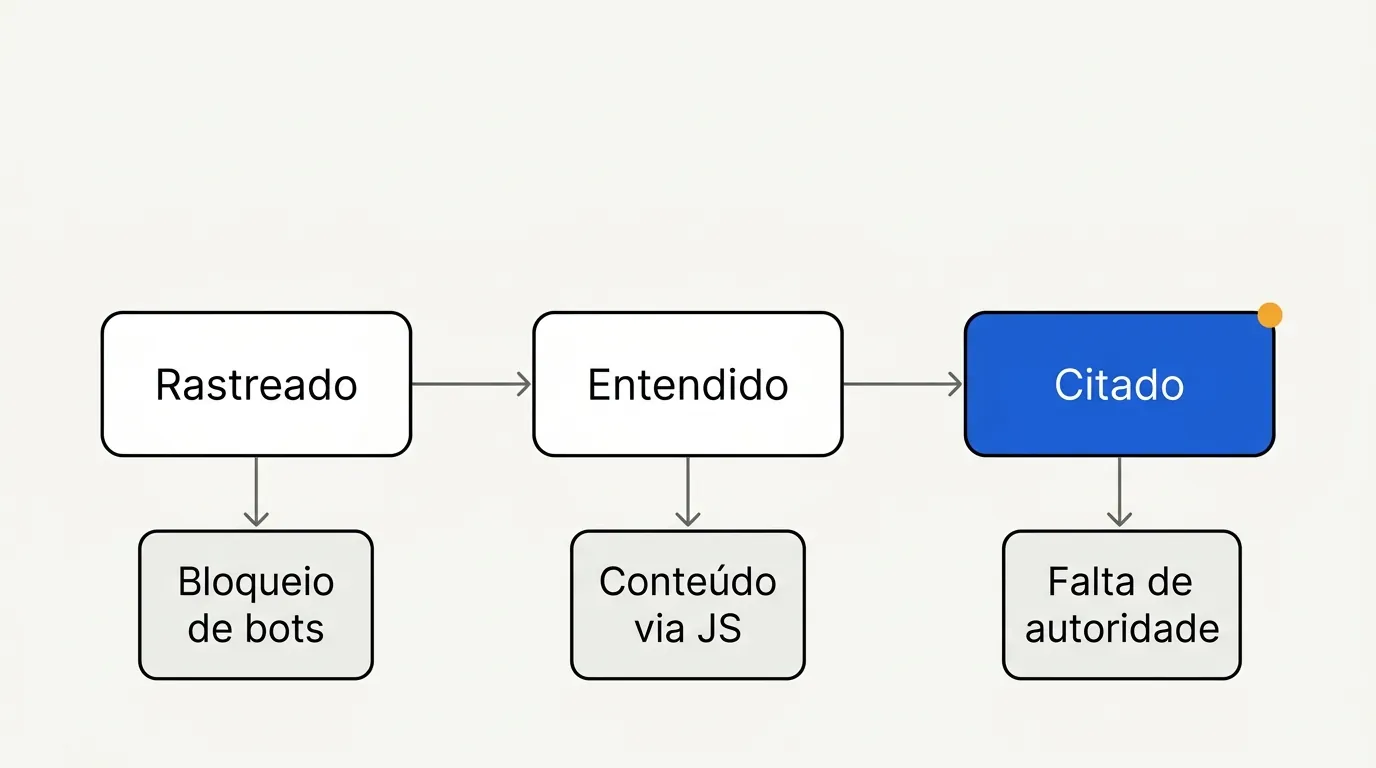
- GEO only works on top of three stages, in this order: getting crawled, getting understood, getting cited. Skipping one invalidates the ones that follow.
- AI Overviews already cut Google's position 1 CTR by 58%, according to an Ahrefs study of 300,000 keywords.
- Most of the web (78% of sites, according to a Cloudflare analysis) still has not made any explicit decision about how to treat AI bots.
- Much of what gets sold as "GEO strategy" has no way to prove causation, and that is a legitimate objection, not an excuse to ignore the topic.
GEO (Generative Engine Optimization) is the set of practices that let AI search engines, such as ChatGPT, Perplexity, and Google's AI Overview, access your content, understand what it answers, and cite your brand in the final response. It does not replace SEO. It depends on it. Without traditional crawling and indexing, there is no citation in AI, because most of these systems still rely, to some degree, on existing search indexes to find what to recommend.
What GEO actually is
SEO optimizes for being found in a list of results. GEO optimizes for being cited inside an answer that is already written. The difference looks subtle, but it changes the end goal: in SEO, the click is the main conversion; in GEO, the brand can "win" with no click at all, just by appearing in the text the user reads.
That does not make SEO obsolete. The architecture behind most AI search systems depends on information retrieval before generating the answer: the model looks up relevant pages, sometimes through its own index, sometimes reusing existing search infrastructure, and only then synthesizes the final text. If the page is not indexed, is not technically accessible, or does not answer the question clearly, it never enters that retrieval process, no matter how well structured the rest of your GEO work is (blog.apiki.com).
A Gartner projection from February 2024 estimates a 25% drop in traditional search volume by the end of this transition period, as AI assistants and search agents absorb part of the research process that used to run through Google alone (Gartner, via blog.apiki.com). That does not mean the end of search. It means search is fragmenting into more surfaces, and each one has its own rules for access and citation.
The three stages of GEO, in the right order
Most GEO guides jump straight to "writing techniques AI likes." That ignores the fact that before any content technique makes a difference, the bot needs to be able to reach the page and process what is on it. These are three sequential stages, and skipping one invalidates the effort on the ones that follow.
Stage 1: getting crawled
Training, search, and agent AI bots are different entities, with different user agents, and each one requires its own access decision. Blocking everything indiscriminately in robots.txt, a common practice today, also blocks the bots that could generate citation or referral traffic.
The full guide, with ready-to-use robots.txt configurations and how to confirm in your logs who is actually accessing the site, is in blocking or allowing AI bots.
Stage 2: getting understood
Crawling is not the same as understanding. A crawler can access the page and still extract nothing useful, because the relevant content only appears after JavaScript renders, or because the critical information is locked inside a format the bot does not process well.
A Cloudflare analysis of 200,000 domains found that only 3.9% of sites serve any Markdown version of their content, and fewer than 15 sites exposed an MCP server for AI agents (via dynamicasoft.com). Most of the web has never tested what an AI crawler actually receives when it visits its most important pages.
The full technical checklist, with practical view-source and curl tests to confirm this on your own site, is in technical checklist for AI crawlers and agents.
Stage 3: getting cited
Only after solving access and readability does it make sense to talk about citation. And here the metric shifts from "ranking" to "mention rate": in how many runs of a fixed set of questions your brand appears, with or without a link, and in what position within the answer.
The practical measurement method, including a manual routine that does not require a paid tool, is in how to measure brand visibility in ChatGPT and Perplexity.
The impact already happening in traffic
While GEO is still a medium-term investment, the side effect of AI answers on traditional organic traffic is already measurable today. The Ahrefs study of 300,000 keywords found a 58% CTR drop at position 1 for searches with AI Overview, getting worse with every update to the research since the first measurement in April 2025, when the recorded drop was 34.5% (ahrefs.com).
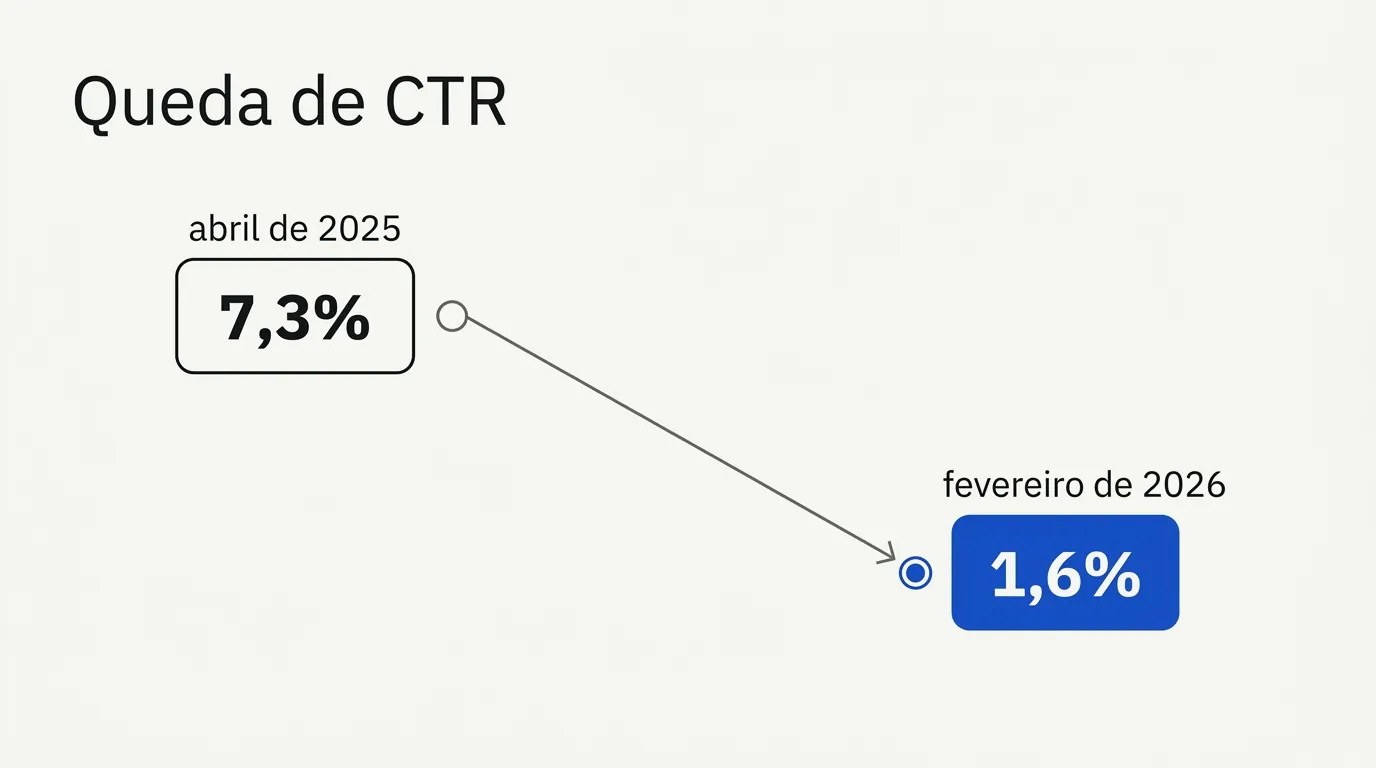 This creates a dynamic that catches a lot of SEO teams off guard: impressions in Search Console rise or stay stable, because the page keeps getting picked as a source, but clicks fall, because the user reads the answer directly in the AI-generated summary and does not need to visit the site. The full breakdown of how to separate this in Search Console, and what to measure instead of raw clicks, is in AI Overviews and the CTR drop.
In practice: if someone on your team is reporting "traffic dropping for no apparent reason" and page rankings have not changed, the first hypothesis to rule out today is AI Overview, not a penalty or a technical error.
llms.txt: the shortcut most people are trying (without results)
Given the size of the shift, it is natural for the market to look for a simple technical shortcut to "solve GEO." The most popular candidate today is llms.txt, a file that promises to list which pages AI should prioritize. The problem is that the available data does not support that expectation: an Ahrefs study of 137,000 domains found that 97% of published llms.txt files never received a single request, and Google confirmed publicly, through Gary Illyes, that Search does not use the file and has no plans to start (oxigenweb.com.br).
That does not mean the file is useless in every scenario, only that it is not the GEO shortcut the marketing around it suggests. The full analysis, with the five studies that reached the same conclusion independently and the specific cases where it is still worth implementing, is in does llms.txt work?
The debate nobody settles: does GEO actually work?
It is worth being honest about a point that runs through much of the discussion among SEO professionals today: proving that a specific GEO action caused an increase in citation is much harder than proving an SEO action caused a ranking increase. An LLM's answer changes between runs of the same question, varies by platform, and there is no single reliable dashboard that isolates "this went up because I did X" from the model's own natural variance.
That creates a real and uncomfortable situation: professionals getting client requests to "do AEO/GEO" without ever having done it before, then having to prove the work produced results, with measurement tools that are still immature and expensive, and competition among vendors who sell the discipline as more mature than it actually is.
The most honest position, in my opinion, has two parts: yes, it is worth investing in the three technical stages (crawled, understood, cited), because they have a concrete, testable effect, whether or not there is an AI traffic "boom" in your specific niche; and no, it is not worth promising clear causation on top of citation metrics that are still unstable. Treat GEO as well-executed technical SEO with a new measurement layer, not as a parallel discipline with its own rules and guarantees that traditional SEO never had.
Why big brands start ahead
A pattern that shows up often in citation studies: broad reference sources, such as Wikipedia, dominate a disproportionate share of LLM citations simply through volume and accumulated authority, not because they specifically optimized for it. The same applies to large brands that are already established and cited across multiple sources on the web: they enter model training and context retrieval with a structural advantage.
If you are not a big brand, the reason to keep going is to set the right expectation: the most realistic gain for most sites is far from "showing up ahead of established brands on any generic question in the niche." It is showing up well on specific, long-tail questions, where competition for citation is lower and the odds of your specific page being the most relevant source go up.
What changes depending on the type of site
GEO does not weigh the same for everyone. It is worth calibrating priority by business type before copying a generic checklist:
- Editorial content and authority blogs. This is the profile most exposed to citation competition, because it competes directly with broad reference sources. Here the return on investing in the three stages tends to be more visible, but it is also where the CTR drop from AI Overview, covered in AI Overviews and the CTR drop, hurts the most.
- SaaS and software products. Technical documentation is the biggest real opportunity here: it is the type of content that AI coding assistants and developer tools actually consume, including via llms.txt (see the use cases that work in does llms.txt work?). Comparison pages (
/vs,/alternatives) also carry disproportionate weight here. - E-commerce. The sheer volume of product pages makes it unfeasible to optimize for AI citation item by item. Effort pays off more concentrated on category pages, buying guides, and comparison content, and on making sure product data (price, availability, specs) sits in the visible text, not only in schema or in tables generated via JavaScript.
- Local service providers. The CTR drop from AI Overview affects this profile less, because most local searches carry transactional intent that rarely fits entirely inside an AI summary. Here, GEO priority is lower than well-executed local SEO.
| Site type | GEO priority | Where to focus effort |
|---|---|---|
| Editorial and authority blogs | High | The three full stages (crawled, understood, cited), as this is the profile most exposed to citation competition |
| SaaS and software products | Medium-high | Technical documentation and comparison pages (/vs, /alternatives) |
| E-commerce | Medium | Category pages, buying guides, and product data in visible text |
| Local service providers | Low | Local SEO remains more relevant than GEO, due to transactional intent |
A 90-day plan to get started without getting lost in hype
- Week 1 to 2: technical diagnosis. Run the AI crawler readiness checklist on your site's 10 most important pages. Confirm in robots.txt that search/citation bots are not accidentally blocked, using the AI bots guide.
- Week 3 to 4: citation baseline. Build a list of 20 to 40 real prompts from your niche and run the first round of manual measurement, as described in brand visibility in ChatGPT and Perplexity. Without a baseline, any future action is impossible to evaluate.
- Week 5 to 8: technical fixes. Resolve what the diagnosis found: rendering that hides content, critical metadata with no equivalent in visible text, no real FAQ. Do not start with new content before fixing what already exists.
- Week 9 to 12: second measurement and metric adjustment. Repeat the prompt round, compare it to the baseline, and cross it with the Search Console performance report to separate the AI Overview effect (see the CTR drop) from the real GEO effect.
This cycle does not promise "showing up in ChatGPT in 90 days." It promises a measurable process, which is more than most "GEO strategy" requests manage to deliver today.
Is a GEO tool a prerequisite?
No. The process described above runs entirely with a spreadsheet, Search Console access, and the free AI products (ChatGPT, Perplexity, Gemini). Specialized "AI visibility" tools solve scale and measurement frequency. They do not replace the technical diagnosis of stages 1 and 2.
Be wary of any tool that hands you only an aggregate score without showing the raw answer behind the number, and of any price comparison made without accounting for the natural variance between runs of the same prompt: part of the market's justified skepticism toward these tools comes from clients who paid a lot and could not validate whether the number changed because of their own work or because of model noise. Ask to see the raw data before signing any recurring contract.
Frequently asked questions
No. GEO depends on well-executed technical SEO for the page to even enter the information retrieval process that feeds an LLM's answer.
If I had to pick a starting point, it would be the view-source test from the AI crawler readiness checklist, run on one important page of the site. It shows within minutes whether the technical basics are in place, and that diagnosis matters more than any strategy discussion.

Lucas Cassapula
Partner & Head of SEO at Wesearch and Co-founder of Mentionflow
I am a partner at Wesearch and co-founder of Mentionflow. I have worked with SEO for almost 10 years. I am a data-driven geek who is always testing hypotheses, looking for patterns and turning ideas into products. I share studies, experiments and automations focused on SEO and GEO.