
Reference content for AI and traditional search
context
Klabin is one of the world’s largest companies in the paper industry. It had deep technical knowledge about paper types, specifications and applications, but that knowledge was difficult to find and was not structured for either search engines or generative AI systems.
challenge
The content had to be easy for people to understand, correctly interpreted by traditional search engines and reusable by generative AI systems. Meeting all three requirements demanded a different approach from conventional SEO publishing.
approach
The project began with detailed search-intent mapping. The semantic structure followed what people genuinely needed to learn, using a clear topic hierarchy and accessible language without losing technical precision.
E-E-A-T principles were applied through contextualized technical explanations, useful references and real examples. Experience and authority emerged from the quality and organization of the information rather than from institutional claims.
outcome
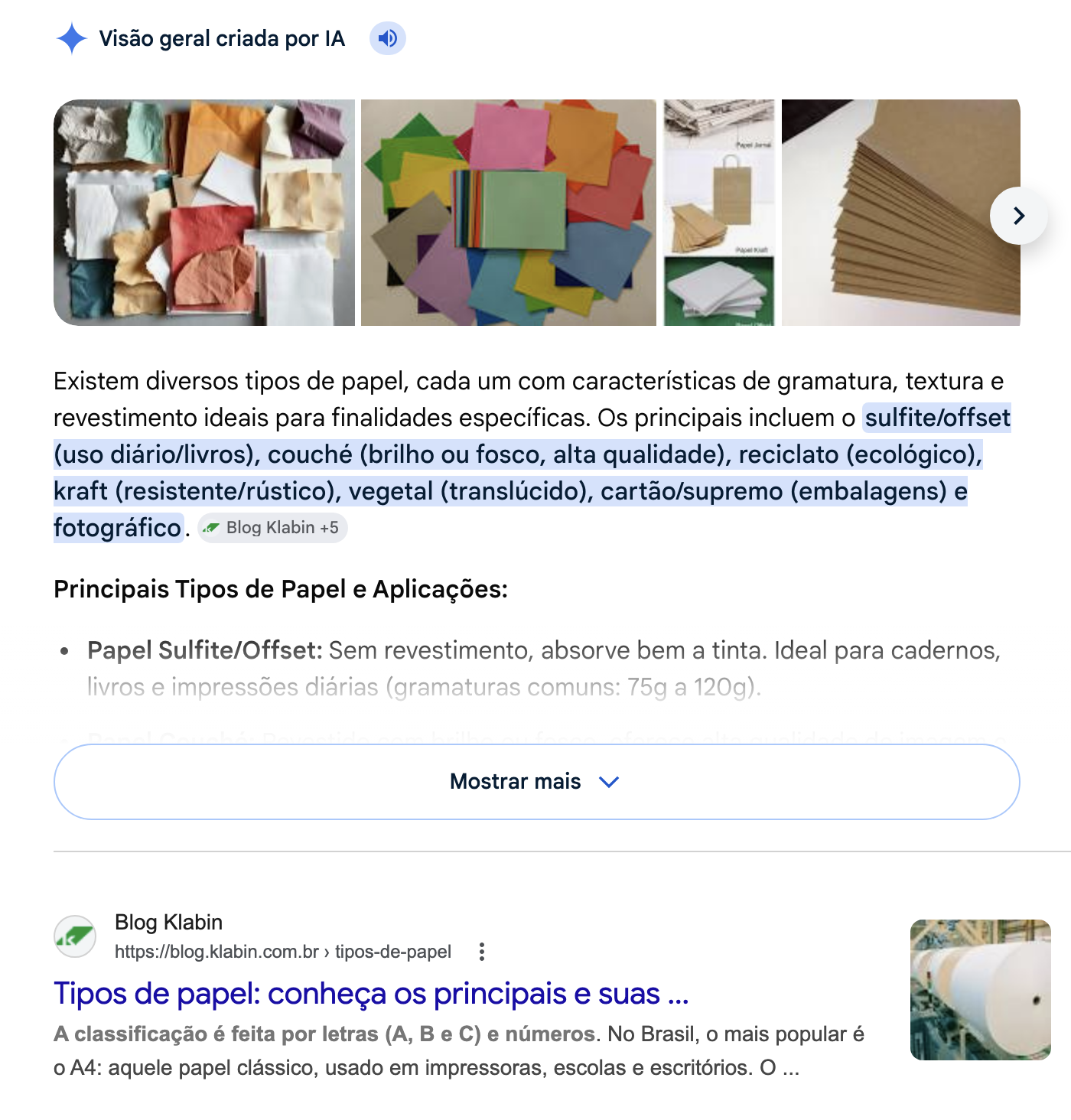
The page reached the first organic position in Brazil for “tipos de papel” and Google also used it as a source for an AI Overview on the same query. The result suggests that AI-cited content is not necessarily the longest or oldest; it is content structured well enough to be interpreted and reused.
learnings
SEO and GEO are complementary. Clear intent, semantic organization and genuine authority can make the same page useful to both traditional ranking systems and generative search.

Lucas Cassapula
Partner & Head of SEO at Wesearch and Co-founder of Mentionflow
I am a partner at Wesearch and co-founder of Mentionflow. I have worked with SEO for almost 10 years. I am a data-driven geek who is always testing hypotheses, looking for patterns and turning ideas into products. I share studies, experiments and automations focused on SEO and GEO.